

Description
PrymaLab · Research Use Only
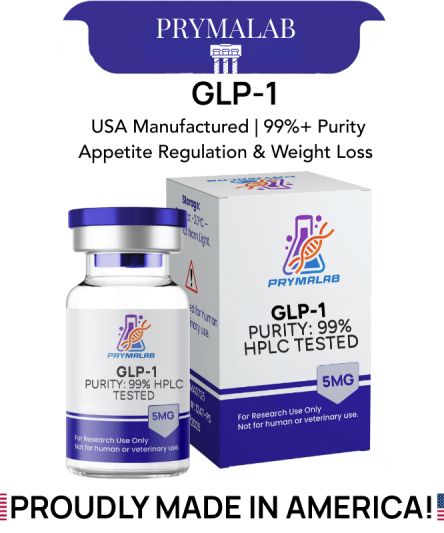
GLP-1 5mg
Glucagon-like peptide-1 (7-36) amide · CAS 107444-51-9 · 3297.69 Da
GLP-1 5mg peptide is a lyophilized vial of glucagon-like peptide-1 (7-36) amide, CAS 107444-51-9, molecular weight 3297.69. This is the native 30-residue sequence with an amidated carboxy terminus, not a stabilised analogue, and its lability to dipeptidyl peptidase-4 is the defining experimental characteristic.
Specification Table
| Property | Value |
|---|---|
| Compound | Glucagon-like peptide-1 (7-36) amide |
| Common designation | GLP-1 |
| CAS number | 107444-51-9 |
| Molecular weight | 3297.69 g/mol |
| Residue count | 30 |
| Single-letter sequence | HAEGTFTSDVSSYLEGQAAKEFIAWLVKGR-NH2 |
| C-terminus | Amidated |
| Numbering convention | Residues numbered 7 to 36 by convention, reflecting the proglucagon precursor |
| Precursor | Proglucagon, processed by prohormone convertase 1/3 |
| Molecular target | GLP-1 receptor (GLP1R), a class B G protein-coupled receptor |
| Principal signalling route | Gs coupling, adenylate cyclase, cyclic AMP, protein kinase A and Epac2 |
| Principal degrading enzyme | Dipeptidyl peptidase-4, cleaving after alanine at position 8 |
| Principal metabolite | GLP-1 (9-36) amide |
| Relationship to stabilised analogues | This is the native sequence. Analogues carry substitutions or conjugations it lacks |
| Oxidation-prone residues | One tryptophan at position 31 |
| Appearance | White lyophilized powder |
| Purity | Per lot-specific certificate of analysis |
| Solubility | Water soluble. Slightly alkaline buffer aids dissolution |
| Storage, lyophilized | -20°C, protected from light and moisture |
| Regulatory status | No approved human or veterinary formulation of the native peptide |
Why Is the Numbering 7 to 36?
The convention confuses people who encounter it for the first time, and the explanation is entirely about the precursor rather than about the peptide itself.
Proglucagon is a large precursor protein processed differently in different tissues. In pancreatic alpha cells, prohormone convertase 2 releases glucagon. In intestinal L cells and in certain brain regions, prohormone convertase 1/3 releases a different set of products, including GLP-1.
The GLP-1 sequence within proglucagon was originally numbered from the start of the proglucagon-derived GLP-1 region, and the biologically active form begins at what that numbering calls residue 7. Residues 1 to 6 are removed during processing and the 30-residue peptide that findings retained the original numbering.
This is why the same molecule appears as GLP-1 (7-36) amide, as GLP-1 7-36, and simply as GLP-1 in different sources. All three refer to the 30-residue active form.
A related form, GLP-1 (7-37), carries an additional glycine and is not amidated. Both occur naturally and both are active at the receptor, which is one more reason to check exactly which form a given paper or product refers to.
What Makes DPP-4 Lability the Defining Property?
The peptide supplied as GLP-1 5mg peptide is cleaved rapidly by dipeptidyl peptidase-4, and everything about how this compound behaves experimentally follows from that.
DPP-4 removes the amino-terminal dipeptide from substrates with alanine or proline in position 2. GLP-1 (7-36) amide has alanine at position 8, which is position 2 of the peptide as it exists, making it an efficient substrate.
Cleavage produces GLP-1 (9-36) amide, which binds the receptor with much lower affinity. The conversion is fast enough in plasma that the native peptide has a circulating half-life measured in minutes rather than hours.
For experimental work this has direct consequences. Any system containing DPP-4 activity, including most plasma and serum preparations and many tissue samples, will convert the peptide during the experiment. A concentration measured at the start is not the concentration present later.
DPP-4 inhibitors such as sitagliptin or diprotin A are the conventional way to control this, and including one is often necessary rather than optional. Reporting whether an inhibitor was present is essential for a finding to be interpretable, and its absence is a common omission.
This lability is precisely why stabilised analogues exist, and it is why the native peptide is the appropriate tool for questions about the receptor rather than about sustained exposure.
How Does the GLP-1 Receptor Signal?
GLP1R is a class B G protein-coupled receptor, sharing that architecture with the GHRH, glucagon and calcitonin receptors.
Its large extracellular domain binds the carboxy-terminal portion of the peptide, while the amino terminus engages the transmembrane bundle. That two-domain arrangement explains why amino-terminal truncation by DPP-4 is so consequential: the removed dipeptide is part of the activating contact.
Coupling is predominantly to Gs, raising cyclic AMP. Two downstream effectors follow: protein kinase A, and Epac2, a cyclic AMP-activated guanine nucleotide exchange factor. The two arms are separable pharmacologically, which is useful for dissecting which contributes to a given readout.
Beta-arrestin recruitment follows agonist binding and contributes both to desensitisation and to distinct signalling, and biased agonism at this receptor is an active area of study.
Receptor expression extends beyond pancreatic beta cells to regions of the central nervous system, the gastrointestinal tract, the heart and elsewhere, which means a receptor-level finding in one tissue does not transfer automatically to another.
What Does GLP-1 5mg Peptide Research Require?
That lability shapes GLP-1 5mg peptide control requirements more than the receptor pharmacology does.
A DPP-4 inhibitor arm, or at minimum a documented statement of DPP-4 activity in the system, is the first requirement. Without it, the effective concentration over the course of an experiment is unknown.
A GLP-1 (9-36) amide arm is worth including where feasible. The metabolite is not inert, and published work has examined whether it carries activity of its own. Running it separately distinguishes parent effects from metabolite effects.
Receptor antagonism, using exendin (9-39), establishes receptor dependence. An effect persisting under antagonism is not GLP1R-mediated, and given the breadth of receptor expression that check has real value.
Concentration-response covering the low nanomolar range is appropriate, since receptor affinity sits there and higher concentrations risk engaging related class B receptors given the sequence homology within that family.
Time course matters more than for a stable peptide. Sampling at a single late timepoint in a DPP-4-containing system measures the metabolite as much as the parent.
How Do Native and Stabilised Sequences Differ as Tools?
The native peptide and the modified analogues answer different experimental questions, and choosing between them on potency alone misses the distinction.
The native sequence gives a brief, defined receptor exposure. That suits acute signalling measurements, receptor kinetics, competitive binding, and any design where a sustained ligand presence would obscure the readout through desensitisation.
Stabilised analogues achieve their persistence through substitution at the cleavage site, fatty acid conjugation promoting albumin association, or fusion to a larger carrier. Each modification changes the molecule beyond its protease resistance.
A substitution at position 8 alters a residue that participates in receptor contact, so receptor pharmacology is not necessarily identical. Fatty acid conjugation adds a hydrophobic element that affects membrane association and biodistribution independently of receptor binding.
Consequently a stabilised analogue is not simply the native peptide with a longer duration. It is a different molecule with its own pharmacology, and findings obtained with one do not transfer automatically to the other.
For receptor-level questions the native sequence with an appropriate protease inhibitor is the cleaner tool, because it isolates the receptor interaction from the chemistry added to extend exposure.
Which Peptidases Beyond DPP-4 Matter?
Attention concentrates on one enzyme, and at least two others act on this sequence in ways that affect experimental interpretation.
Neutral endopeptidase, also called neprilysin, cleaves at multiple internal sites within the sequence. Unlike the amino-terminal dipeptide removal, endopeptidase cleavage destroys the molecule rather than converting it to a defined lower-affinity species.
That distinction matters for measurement. An immunoassay directed at the amino terminus will not distinguish intact peptide from a fragment cleaved internally if the epitope survives, so apparent concentration can exceed functional concentration substantially.
Plasma kallikrein and other proteases contribute additional processing in complex biological matrices, and the relative contribution varies with the matrix used.
The practical consequence is that a DPP-4 inhibitor alone does not guarantee peptide integrity. A broad peptidase inhibitor cocktail is appropriate for work in plasma or tissue preparations, and mass spectrometry rather than immunoassay is the reliable way to confirm what remains.
Reporting which inhibitors were present, and which detection method was used, is what allows a concentration figure in this area to be taken at face value.
What Does GLP-1 5mg Peptide Support in Practice?
Five milligrams of a 30-residue peptide is a substantial molar quantity, and receptor work uses it slowly.
At 3297.69 daltons the vial supplies approximately 1.52 micromoles. Receptor-level assays operate in the low nanomolar range, so a single vial covers a very large number of wells even allowing for the generous concentration ranging that class B receptor pharmacology warrants.
What consumes GLP-1 5mg peptide faster is the control burden. A protease inhibitor comparison, a metabolite arm, an antagonist arm and a time course together multiply the well count considerably.
Work in plasma or tissue matrices consumes more again, because peptide is lost to degradation during the experiment rather than only being measured.
Adsorption accounts for a further fraction that is easy to miss. Low-binding plastic and a carrier protein reduce it.
Reconstitution and Storage in Laboratory Practice
Five milligrams at 3297.69 daltons is approximately 1.52 micromoles. Reconstituted into 1 ml that gives roughly 1.52 mM, well above typical working concentrations.
Dissolution is aided by slightly alkaline conditions. The sequence carries several acidic residues and dissolves more readily above its isoelectric point, so a mildly alkaline buffer works better than plain water for a concentrated stock.
The single tryptophan at position 31 is the only oxidation-sensitive residue and provides absorbance at 280 nm for concentration determination. Protect from light and minimise air exposure, though with one oxidisable residue the risk is moderate.
At 30 residues with amphipathic character, adsorption to surfaces is a real concern at working concentrations. Low-binding consumables are worth using, and a carrier protein such as bovine serum albumin is often included where the assay permits.
Keep dry material at -20°C, sealed, dark and dry. In solution, hold at 2-8°C, divide before freezing, and use it promptly rather than storing it. Record lot, diluent identity and pH, volume, concentration, and whether any protease inhibitor was included.
Published Literature
References verified against the publisher record. GLP-1 receptor biology rests on a very large and independent literature.
- Drucker DJ. Cell Metabolism. 2018;27(4):740-756.
- Baggio LL, Drucker DJ. Gastroenterology. 2007;132(6):2131-2157.
- Mentlein R, Gallwitz B, Schmidt WE. European Journal of Biochemistry. 1993;214(3):829-835.
- Holst JJ. Physiological Reviews. 2007;87(4):1409-1439.
- Graaf C de, Donnelly D, Wootten D, Lau J, Sexton PM, Miller LJ, Ahn JM, Liao J, Fletcher MM, Yang D, Brown AJ, Zhou C, Deng J, Wang MW. Pharmacological Reviews. 2016;68(4):954-1013.
Frequently Asked Questions
What is GLP-1 5mg peptide?
A lyophilized vial of glucagon-like peptide-1 (7-36) amide, CAS 107444-51-9, molecular weight 3297.69, 30 residues with an amidated carboxy terminus. This is the native sequence rather than a stabilised analogue. Laboratory research use only.
Why is it numbered 7 to 36?
Because of the proglucagon precursor. The GLP-1 region within proglucagon was originally numbered from its own start, and the biologically active form begins at what that numbering calls residue 7. The 30-residue product retained the original numbering.
What is GLP-1 (7-37)?
A related naturally occurring form carrying an additional glycine and lacking the amide. Both it and the 7-36 amide are active at the receptor, which is one reason to check exactly which form a given paper or product refers to.
Why is DPP-4 lability so important?
Because it defines how the peptide behaves in any experiment. Dipeptidyl peptidase-4 removes the amino-terminal dipeptide from substrates with alanine or proline in position two, and this peptide has alanine there, making it an efficient substrate.
What does cleavage produce?
GLP-1 (9-36) amide, which binds the receptor with much lower affinity. The conversion is fast enough in plasma that the native peptide has a circulating half-life measured in minutes rather than hours.
How is that controlled experimentally?
With a DPP-4 inhibitor such as sitagliptin or diprotin A, which is often necessary rather than optional. Reporting whether an inhibitor was present is essential for a finding to be interpretable, and its absence is a common omission in this area.
How does the receptor signal?
As a class B G protein-coupled receptor coupling predominantly to Gs, raising cyclic AMP. Two downstream effectors follow, protein kinase A and Epac2, and they are separable pharmacologically, which helps in dissecting which contributes to a given readout.
Why does amino-terminal truncation matter so much?
Because class B receptors bind through two domains. The extracellular domain binds the carboxy-terminal portion while the amino terminus engages the transmembrane bundle, so the dipeptide DPP-4 removes is part of the activating contact.
Is the metabolite inert?
Not necessarily. Published work has examined whether GLP-1 (9-36) amide carries activity of its own, so running it as a separate arm distinguishes parent effects from metabolite effects rather than assuming the cleavage product does nothing.
How should dissolution be handled?
Slightly alkaline conditions help. The sequence carries several acidic residues and dissolves more readily above its isoelectric point, so a mildly alkaline buffer works better than plain water for preparing a concentrated stock.
Compliance Statement
GLP-1 is sold exclusively for laboratory research use. It is not a drug, food, or cosmetic product, and it is not a dietary product of any kind. It is not approved by the FDA or any comparable authority for human or veterinary use, it is the native peptide sequence supplied as a receptor pharmacology reagent, and no approved formulation of the native peptide exists. This product is not intended to diagnose, treat, cure, or prevent any disease. It must not be given to humans or animals. Purchase is restricted to qualified researchers and institutions operating within applicable laws. All handling is the responsibility of the purchasing laboratory.










5 reviews for GLP-1 5mg